
Grease trap for restaurant owners becomes a $15,000 annual mistake when you make decisions without understanding your actual requirements. Most restaurant operators choose based on price alone, then pay thousands in emergency pumping, violations, and premature replacement.
Key Takeaways:
• Restaurant grease trap decisions follow a 6-step framework: need assessment, sizing calculation, product selection, installation planning, maintenance setup, and cost analysis
• Under-sizing costs restaurants $2,400-8,200 in emergency pumping and violations annually, while over-sizing wastes $1,500-4,000 in unnecessary capacity
• Total 5-year ownership costs range from $8,500 for small under-sink units to $47,000 for large underground interceptors when you factor in pumping, permits, and maintenance
How Do You Determine if Your Restaurant Actually Needs a Grease Trap?

Restaurant FOG program management requires a decision tree for need assessment that cuts through municipal confusion. Most restaurant owners get conflicting advice from contractors, inspectors, and neighboring businesses about grease trap requirements.
The determination process breaks down into four sequential steps:
Analyze your food service type and cooking methods. Restaurants using fryers, grills, or sautéing equipment produce enough fats oils and grease (FOG) to trigger mandatory installation in 47 states. Coffee shops serving only pastries and sandwiches typically fall below thresholds.
Check local jurisdiction discharge limits for your specific location. Jurisdictions require grease traps when restaurants discharge more than 25 mg/L of FOG to municipal sewers. Contact your wastewater authority directly, not general city offices.
Calculate total fixture loading from all kitchen equipment. Count every sink, dishwasher, floor drain, and prep station that handles food waste or cleaning water. Single-fixture operations under 15 GPM sometimes qualify for exemptions.
Verify wastewater discharge destination and permits required. Restaurants connected to septic systems follow different rules than those discharging to municipal treatment plants. Private wastewater systems often have stricter FOG limits.
Restaurant FOG program management becomes mandatory once any single step triggers installation requirements. The decision tree eliminates guesswork and prevents costly assumption-based purchases that fail inspection.
What Size Grease Trap Does Your Kitchen Configuration Actually Need?
Sizing for your kitchen determines grease trap service contract requirements and total operating costs over the system’s lifetime. Fast-casual restaurants require 14-35 GPM capacity while full-service establishments need 35-75 GPM based on seat count and kitchen complexity.
The sizing methodology combines fixture unit calculations with peak flow analysis. You calculate total GPM by adding flow rates from all connected fixtures, then multiply by a safety factor based on simultaneous use patterns. Quick-service operations with limited menu variety use lower multipliers than full-service kitchens with complex preparation.
Restaurant FOG program management requires accurate capacity planning that accounts for growth. Under-sized systems overflow when kitchen volume increases during busy periods or menu expansion. Over-sized systems waste money on unnecessary pumping frequency without improving grease separation efficiency.
| Restaurant Type | Typical GPM Range | Sizing Factors | Service Frequency |
|---|---|---|---|
| Coffee Shop | 7-15 GPM | Minimal cooking, pastry prep | 90-120 days |
| Quick Service | 14-25 GPM | Fryers, limited prep | 60-90 days |
| Fast Casual | 20-35 GPM | Grills, multiple stations | 45-60 days |
| Full Service | 35-75 GPM | Complex prep, full kitchen | 30-45 days |
| High Volume | 75-150 GPM | Multiple fryers, large capacity | 21-30 days |
Grease trap service contract costs scale directly with system size and pumping frequency. Accurate sizing prevents emergency service calls that cost 3-4 times regular maintenance rates. The sizing calculation becomes the foundation for all downstream decisions about product selection, installation planning, and cost budgeting.
Which Grease Trap Product Should You Choose for Your Specific Operation?
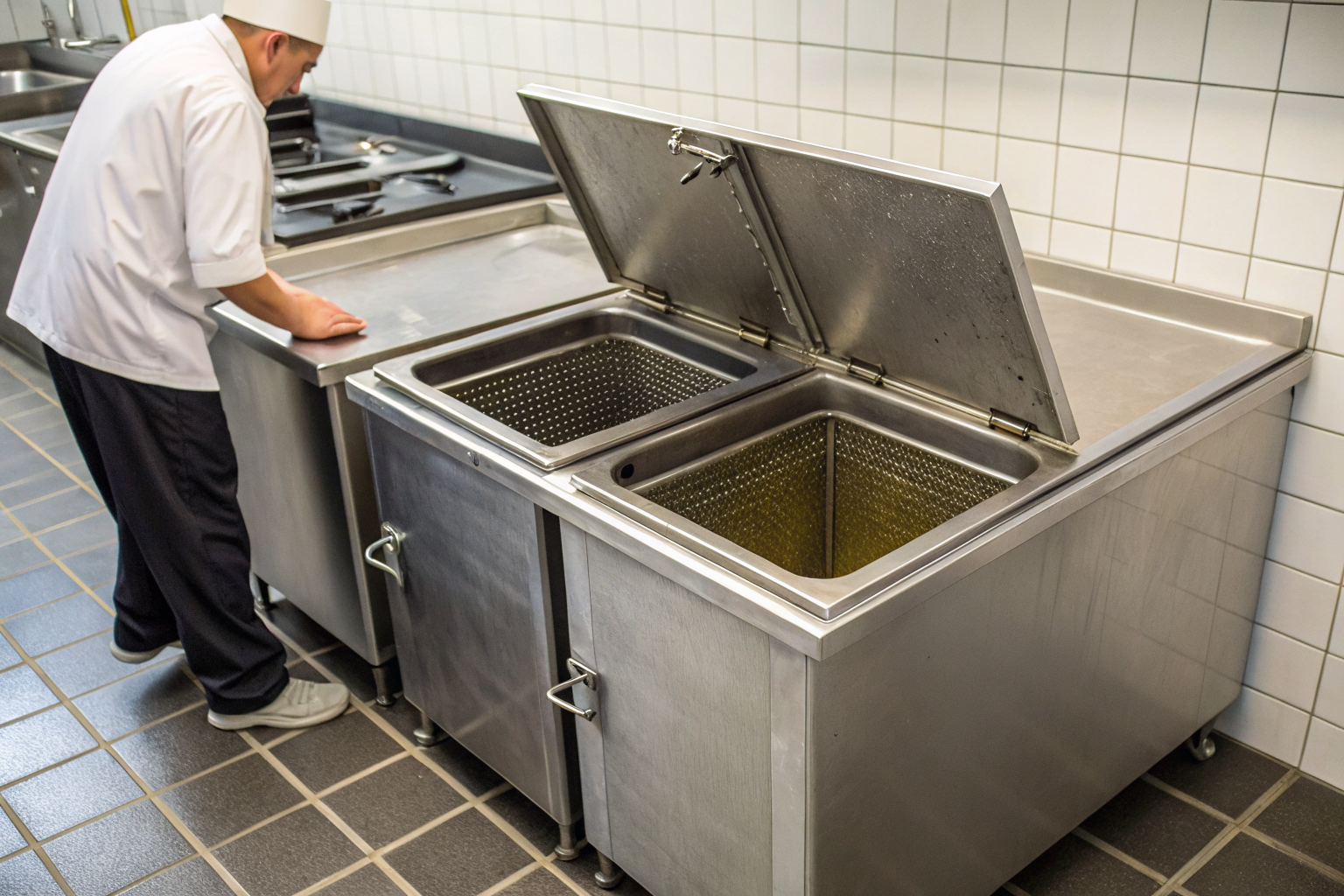
Product selection guidance influences total cost of ownership calculations across equipment purchase, installation, and maintenance over 10-15 years. Stainless steel units cost 40-60% more initially but last 15-20 years compared to 8-12 years for polyethylene.
The selection matrix weighs space constraints, capacity requirements, and budget considerations against performance specifications. Under-sink units work for smaller operations with limited space but require more frequent cleaning. Underground interceptors handle high volumes efficiently but need excavation and higher installation costs.
Groase hauling business operations affect product choice through access requirements and pumping logistics. Units with difficult access cost more to service because haulers charge premium rates for challenging locations or extended setup time.
| System Type | Capacity Range | Space Requirements | Installation Complexity | Maintenance Access |
|---|---|---|---|---|
| Under-Sink | 7-40 GPM | Minimal footprint | Simple plumbing | Easy interior access |
| Floor-Mounted | 25-75 GPM | Kitchen floor space | Moderate installation | Direct access required |
| Underground | 50-200 GPM | Exterior excavation | Complex civil work | Outdoor access only |
| Automatic | 15-100 GPM | Equipment room space | Electrical and plumbing | Technical service needed |
Material selection balances durability against cost. Polyethylene units cost less initially but crack under temperature stress and impact damage. Stainless steel handles thermal shock and mechanical abuse but requires higher upfront investment. Cast iron provides maximum durability but adds significant weight and installation complexity.
The product decision locks in operating costs for the system’s entire lifecycle. Choose based on total cost of ownership rather than purchase price alone to avoid expensive mistakes.
Installation Planning: Permits, Placement, and Professional Requirements
Installation process overview requires licensed grease hauler coordination for proper connection to FOG control program requirements. Installation permits cost $150-800 and require 2-6 weeks processing time in major metropolitan areas.
The installation timeline follows specific sequences that prevent delays and code violations:
Submit permit applications with detailed plans and specifications. Include system capacity calculations, placement drawings, and connection details to existing plumbing. Most jurisdictions require professional engineer stamps for systems over 50 GPM.
Schedule contractor selection and coordinate with FOG control program officials. Licensed plumbing contractors handle installation and connection to sewer systems. Unlicensed installation voids manufacturer warranties and fails permit inspections.
Complete site preparation including excavation for underground units. Underground installations require utility marking, soil analysis, and proper bedding material. Access routes must accommodate service vehicles for future maintenance.
Arrange inspection scheduling at rough-in and final completion stages. Inspectors verify proper sizing, installation methods, venting requirements, and connection details. Failed inspections delay operation and add re-inspection fees.
Licensed grease hauler coordination during installation ensures proper manifesting systems and service access requirements. Haulers provide input on access routes, pumping connections, and documentation systems required for FOG control program compliance.
Installation mistakes cost thousands in retrofitting and re-inspection fees. Professional installation with proper permits protects against liability and ensures code compliance from day one.
Setting Up Your Maintenance Program for Long-Term Compliance

Maintenance program setup ensures FOG control program compliance and prevents expensive emergency situations. Restaurants with structured maintenance programs reduce violations by 78% and emergency service calls by 65%.
The maintenance framework coordinates service provider relationships with internal staff responsibilities:
• Service provider selection based on licensing, insurance, and manifest handling capabilities. Verify haulers maintain proper disposal permits and provide complete documentation for regulatory compliance. Compare per-gallon rates against local market averages.
• Cleaning schedule establishment following the 25% rule and local requirements. Monitor grease accumulation weekly and schedule pumping before reaching maximum capacity limits. Document all measurements for inspection records.
• Documentation systems for manifests, inspection reports, and maintenance logs. Maintain complete records for three years minimum or longer based on local requirements. Digital systems reduce paperwork burden and improve compliance tracking.
• Staff training on daily maintenance, monitoring procedures, and emergency protocols. Train kitchen staff to recognize overflow warning signs and proper disposal practices for cooking waste. Establish clear procedures for service interruptions.
Groase trap service contract evaluation focuses on total service value rather than lowest per-gallon rates. Quality contractors provide emergency response, compliance documentation, and preventive maintenance guidance that prevents costly violations.
Maintenance program setup requires ongoing monitoring and adjustment based on actual kitchen performance. Regular evaluation prevents system failures and maintains compliance with evolving FOG control program requirements.
Total Cost of Ownership: 5-Year Financial Analysis by System Type

Total cost of ownership includes grease hauling business operations costs across equipment purchase, installation, permits, regular maintenance, emergency services, and replacement planning. Monthly operating costs range from $85-150 for under-sink units to $400-750 for large underground interceptors including pumping and compliance documentation.
The cost breakdown varies significantly between system types and operational factors. Under-sink units minimize installation costs but require more frequent service. Underground interceptors cost more initially but handle higher volumes with better efficiency.
Groase trap service contract negotiations affect long-term costs through per-gallon rates, emergency service charges, and documentation fees. Contracts should include emergency response and compliance documentation for 15-25% above basic pumping rates.
| System Type | Equipment Cost | Installation Cost | 5-Year Maintenance | Total 5-Year Cost |
|---|---|---|---|---|
| Under-Sink (20 GPM) | $800-1,500 | $500-1,200 | $6,200-8,500 | $8,500-11,200 |
| Floor-Mounted (50 GPM) | $2,500-4,500 | $1,500-3,000 | $12,000-18,000 | $16,000-25,500 |
| Underground (100 GPM) | $8,000-15,000 | $5,000-12,000 | $18,000-24,000 | $31,000-51,000 |
| Automatic (75 GPM) | $15,000-25,000 | $3,000-6,000 | $15,000-20,000 | $33,000-51,000 |
Groase hauling business operations costs fluctuate with fuel prices, disposal fees, and regulatory changes. Factor 3-5% annual increases into long-term budgeting. Emergency service calls cost 300-400% more than scheduled maintenance, making prevention programs essential.
Financing considerations include equipment loans, lease options, and service contracts with included equipment. Lease programs reduce upfront costs but increase total lifetime expenses. Cash purchases provide better ROI for established operations with strong cash flow.
Frequently Asked Questions
What happens if I choose the wrong size grease trap for my restaurant?
Under-sized grease traps overflow frequently and violate the 25% rule, leading to fines averaging $500-2,500 per violation. Over-sized units waste money on unnecessary pumping frequency and higher installation costs without improving performance.
Can I upgrade my grease trap size later if my restaurant grows?
Upgrading requires new permits, excavation for underground units, and potential kitchen modifications for larger above-ground systems. Planning for 20-30% capacity growth during initial selection costs significantly less than retrofitting.
Do I need to use a licensed contractor for grease trap installation?
Most jurisdictions require licensed plumbing contractors for grease trap installation and connection to sewer systems. DIY installation typically voids manufacturer warranties and fails permit inspections.
How do I know if my current grease trap service contract is competitive?
Compare your per-gallon pumping rate against local market averages and verify your hauler provides proper disposal manifests. Service contracts should include emergency response and compliance documentation for 15-25% above basic pumping rates.