

Grease trap repair becomes urgent when most restaurant owners wait until sewage backs up into their kitchen, a mistake that costs $3,000-$8,000 in emergency repairs and fines.
Key Takeaways:
- The 25% rule violation causes 67% of all grease trap failures, triggering sanitary sewer overflow risks
- Emergency grease response costs 4x more than scheduled maintenance, average emergency call runs $1,200 vs $300 routine service
- FOG bypass failure indicates undersizing in 89% of cases, requiring interceptor upgrade rather than simple repair
What Are the Most Common Grease Trap Problems Restaurant Owners Face?
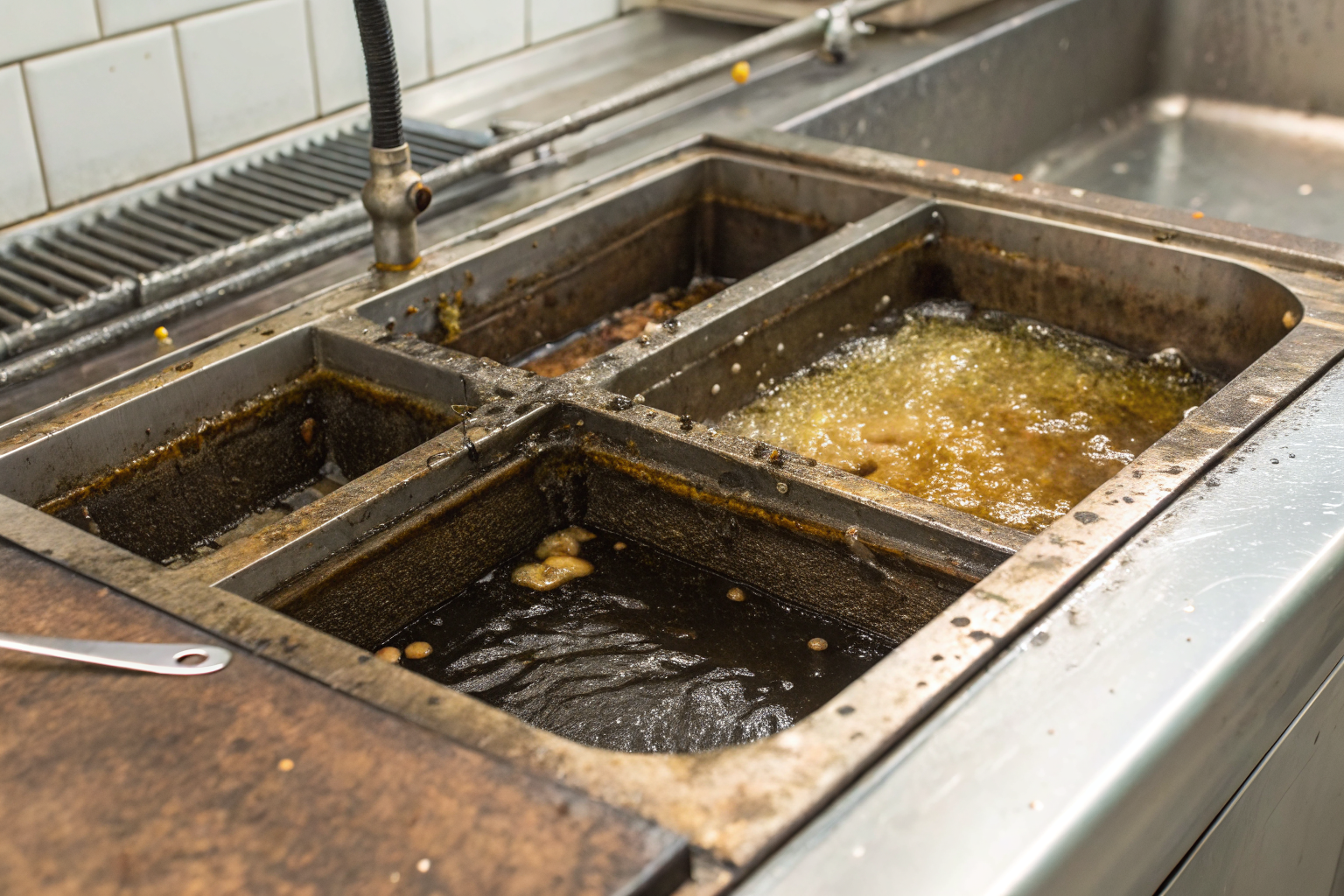
Fats oils and grease (FOG) accumulation creates predictable failure patterns. The 25% rule violation leads to most problems, when grease layers exceed 25% of the trap’s liquid depth, downstream issues multiply.
| Problem Type | Observable Symptoms | Root Cause |
|---|---|---|
| FOG Overflow | Grease floating on water surface | 25% rule violation |
| Sanitary Sewer Overflow | Floor drain backup, odors | Trap capacity exceeded |
| Slow Drainage | Sinks drain sluggishly | Inlet/outlet blockage |
| Gas Emissions | Rotten egg smell, staff complaints | Anaerobic decomposition |
| Structural Damage | Visible cracks, loose fittings | Age or chemical corrosion |
Grease trap symptoms indicate specific failure causes through observable patterns. Kitchen staff notice slow drainage first, then persistent grease odors develop. The progression follows mechanical laws, when fats oils and grease exceed holding capacity, the system fails catastrophically.
Field reports show three failure categories: immediate (complete blockage), progressive (gradual capacity loss), and catastrophic (structural damage causing sanitary sewer overflow). The 25% rule violations account for 67% of all commercial grease trap failures documented by municipal inspectors.
Most restaurant owners mistake normal operational variations for serious problems. A properly functioning trap shows clear water in the outlet chamber with minimal surface grease. When that water turns cloudy or develops a grease film, the trap needs attention.
How Do You Diagnose FOG Bypass Failure vs Normal Operation Issues?

FOG bypass failure indicates trap undersizing or baffle damage requiring systematic diagnosis.
Check outlet water clarity. Clear water with minimal grease indicates normal operation. Cloudy water or visible grease film means FOG bypass failure.
Measure grease layer thickness. Use a measuring stick to check grease depth against total liquid depth. Exceeding 25% confirms operational failure.
Inspect baffle integrity. Look for cracks, loose connections, or missing sections. Damaged baffles allow direct grease bypass.
Test inlet flow rate. Compare actual kitchen discharge against trap capacity rating. Higher flows indicate undersizing.
Document hydrogen sulfide gas presence. Strong rotten egg odors signal anaerobic conditions requiring immediate cleaning.
Examine trap construction. Note material type, age, and previous repairs. Concrete traps older than 12 years show structural weakness.
FOG bypass failure indicates undersizing in 89% of documented cases. When grease consistently passes through despite recent cleaning, the trap lacks sufficient capacity for kitchen demands. This differs from operational issues like infrequent cleaning or damaged components.
Visual inspection reveals the difference. Normal operation shows three distinct layers: bottom sludge, middle water, top grease. FOG bypass creates a uniform mixture where these layers blend together.
Hydrogen sulfide gas indicates severe FOG buildup creating anaerobic conditions. This toxic situation requires immediate professional intervention, not routine maintenance. Staff exposure to these gases creates health hazards beyond equipment problems.
The diagnostic process takes 15-20 minutes for trained personnel. Document findings with photos and measurements for insurance claims or municipal reporting requirements.
When Should You Repair vs Replace Your Grease Trap?

Repair costs exceed replacement value at specific thresholds based on trap age, damage extent, and capacity requirements.
| Decision Factor | Repair | Replace |
|---|---|---|
| Repair Cost vs New Price | Under 60% | Over 60% |
| Trap Age | Under 8 years | Over 12 years |
| FOG Bypass Frequency | Occasional | Monthly or more |
| Structural Integrity | Surface damage only | Cracks through walls |
| Capacity Match | Meets kitchen needs | Undersized for operation |
Replacement becomes cost-effective when repair exceeds 60% of new unit price. This threshold accounts for labor costs, permit requirements, and operational downtime. Older traps approaching this percentage will likely need additional repairs within two years.
Age matters for material degradation. Concrete traps show structural failure after 12-15 years through chemical attack from FOG acids. Polymer traps last 8-10 years before UV degradation weakens the structure. Steel traps suffer corrosion damage within 6-8 years unless properly coated.
FOG bypass failure frequency signals capacity problems requiring upgrades. When a properly maintained trap exceeds the 25% rule monthly, the system lacks sufficient volume for kitchen demands. Repair won’t fix this fundamental sizing mismatch.
Structural damage determines replacement necessity. Surface scratches or minor fitting leaks qualify for repair. Cracks penetrating tank walls create groundwater contamination risks requiring immediate replacement.
Capacity mismatch drives most replacement decisions. Kitchen expansions, menu changes, or increased business volume overwhelm existing traps. Adding grease production equipment like fryers or char broilers often doubles FOG output, making the current trap inadequate.
Financing considerations affect timing. Many operators choose repair for immediate cash flow relief, then plan replacement during slower business periods. This approach works if structural integrity remains intact.
What Warning Signs Mean You Need Emergency Grease Response?

Emergency situations require immediate professional intervention when health hazards or property damage risks develop.
• Sewage backup into kitchen areas creates immediate contamination requiring evacuation until professional cleaning restores sanitary conditions
• Hydrogen sulfide gas concentrations above normal odor levels indicate toxic exposure risks demanding immediate ventilation and staff removal
• Standing water in floor drains combined with grease odors signals sanitary sewer overflow potential requiring emergency pumping
• Visible grease discharge to municipal sewers triggers regulatory violations and potential fines requiring immediate containment
• Structural cracks allowing groundwater infiltration create environmental contamination requiring emergency assessment and temporary containment
• Complete drainage stoppage in grease trap connected fixtures indicates total system failure requiring immediate bypass installation
Emergency grease response costs average $1,200 vs $300 for scheduled maintenance. After-hours service calls, hazmat procedures, and emergency equipment rental drive costs higher. Most emergency situations develop from deferred maintenance rather than sudden equipment failure.
Health hazard indicators require immediate action. Hydrogen sulfide gas concentrations create toxic exposure risks for kitchen staff. Municipal health departments can order facility closure until proper remediation occurs.
Documentation requirements for emergency calls include photos of damage, measurement readings, and timeline of symptom development. Insurance claims and regulatory reporting depend on this initial documentation.
Sanitary sewer overflow creates the most serious emergency situation. Raw sewage backing up through floor drains contaminates the entire kitchen requiring professional sanitization. Some jurisdictions mandate temporary closure until health department approval.
How Do Different Grease Trap Types Fail and What Repairs Work?

Different trap types exhibit specific failure patterns based on construction materials and design approaches.
| Trap Type | Common Failure Mode | Effective Repairs |
|---|---|---|
| Concrete | Structural cracks, corrosion | Epoxy injection, liner replacement |
| Polymer/Fiberglass | UV degradation, fitting failure | Surface coating, gasket replacement |
| Stainless Steel | Corrosion at welds | Welding repair, protective coating |
| Cast Iron | Complete corrosion failure | Replacement only |
| Automatic Systems | Mechanical component failure | Motor/timer replacement |
Concrete traps show structural failure after 12-15 years through acid attack from decomposing fats oils and grease. The alkaline concrete neutralizes FOG acids initially, but sustained exposure creates deep pitting and eventual wall penetration. Epoxy injection works for hairline cracks, but extensive damage requires full liner replacement.
Polymer traps fail after 8-10 years from UV exposure and thermal cycling. Surface crazing allows FOG penetration into the material structure. Food-grade epoxy coatings restore surface integrity for minor damage. Fitting failures around inlet/outlet connections respond well to gasket replacement and proper torque specifications.
Stainless steel construction resists most chemical attack but fails at weld joints where heat treatment creates corrosion-prone zones. TIG welding repairs work well if performed by certified welders using food-grade materials. Protective coatings prevent future corrosion in high-acid environments.
Cast iron traps, common in older installations, suffer complete material failure through oxidation. The porous iron structure accelerates corrosion once FOG acids penetrate the surface. No repair method proves effective, replacement becomes mandatory.
Automatic grease removal devices add mechanical complexity creating additional failure modes. Motors, timers, and sensors require regular replacement based on duty cycle. FOG bypass failure in automatic systems often indicates mechanical malfunction rather than capacity problems.
Manufacturer-specific weak points appear in field data. Zurn traps show inlet baffle cracking. Watts models suffer outlet tee failures. Jay R. Smith units develop gasket leaks at access covers. These patterns help predict repair needs based on trap brand and model.
When Do Grease Trap Problems Signal You Need a Bigger System?

FOG bypass failure is frequent problems indicating system undersizing requiring upgrade rather than continued repairs. This means your current trap lacks sufficient capacity for actual kitchen demands, not just maintenance issues.
Frequent problems indicate capacity mismatch between trap size and actual FOG production. When properly maintained traps violate the 25% rule monthly, the system needs more volume or retention time. Kitchen audits often reveal equipment additions or menu changes that doubled grease output without corresponding trap upgrades.
Capacity problems differ from maintenance issues through timing patterns. Maintenance-related failures occur randomly based on cleaning schedules. Capacity failures follow predictable cycles matching kitchen busy periods, lunch rushes, weekend volume, or holiday cooking.
Upgrade vs repair cost analysis favors replacement when current problems exceed $2,000 annually. Underground interceptor installation costs $8,000-$15,000 but eliminates recurring failure costs. Simple math: three years of problem repairs equal new interceptor cost.
Systems requiring cleaning more than twice monthly indicate 40% undersizing based on municipal data. Standard maintenance schedules assume monthly service maximum. Higher frequencies signal fundamental capacity shortfalls that repair cannot address.
Regulatory pressure often forces upgrades when violations accumulate. Municipal authorities track repeat offenders and mandate capacity increases through permit modifications. Proactive upgrades cost less than court-ordered emergency installations.
Frequently Asked Questions
How do I know if my grease trap is backing up into my kitchen sink?
Standing water in floor drains combined with grease odors indicates backup. If your 3-compartment sink drains slowly or gurgles during use, the trap has likely exceeded the 25% rule and needs immediate pumping.
Can I fix a cracked grease trap myself or do I need a professional?
Structural cracks require professional assessment since they can cause groundwater contamination. Surface scratches on polymer traps can be sealed with food-grade epoxy, but any crack penetrating the tank wall needs replacement.
What should I do if my grease trap is producing hydrogen sulfide smell?
Hydrogen sulfide gas indicates dangerous anaerobic conditions requiring immediate professional cleaning. Evacuate kitchen staff and contact emergency grease response, this situation can create toxic exposure risks.
How much does it cost to upgrade from a grease trap to an interceptor?
Upgrading to an underground interceptor costs $8,000-$15,000 including excavation and permits. Most jurisdictions require interceptors when kitchen capacity exceeds 75 GPM or when repeated trap failures indicate undersizing.