Most restaurants fail their first grease trap compliance audit because they check boxes without understanding what regulators verify during inspections. This grease trap compliance checklist breaks down the specific requirements under commercial grease trap regulations.
Key Takeaways:
- EPA 40 CFR 403 violations cost restaurants $2,500-$25,000 per citation plus potential permit suspension
- Compliant restaurants maintain 14 specific documentation types and run weekly monitoring checks
- Installation verification requires 7 measurable criteria that inspectors check during permit approval
What Documentation Does FOG Compliance Verification Require?

FOG compliance verification requires waste manifest documentation across 14 specific document categories. Each document type serves as evidence during inspections and must be retained for periods ranging from 1-5 years depending on jurisdiction requirements.
Restaurants operating under grease trap requirements must maintain complete paper trails for all FOG-related activities. Missing documentation triggers automatic violations regardless of actual system performance.
| Document Type | Retention Period | FOG Control Program Requirement |
|---|---|---|
| Waste Manifests | 3 years | Required for all waste hauling |
| Pumping Records | 5 years | Must show dates, volumes, disposal sites |
| Inspection Logs | 3 years | Weekly measurements and observations |
| Maintenance Receipts | 5 years | Professional service documentation |
| Training Certificates | 2 years | Staff FOG handling qualification |
Violations for missing paperwork range from $500 for incomplete logs to $5,000 for missing waste manifests. The FOG control program framework requires specific formatting for each document type, with standardized measurement units and signature requirements.
Inspectors verify document authenticity by cross-referencing hauler records and checking measurement consistency patterns. Restaurants that maintain digital backups alongside physical records show 40% fewer documentation violations during audits.
Installation Compliance Verification Steps

Installation compliance verification measures flow capacity requirements against seven specific criteria that inspectors document during the grease trap permit process. Each measurement must fall within EPA 40 CFR 403 specifications or the permit gets denied.
Verify inlet flow rate capacity matches kitchen fixture GPM totals. Inspectors calculate total fixture flow and compare against trap specifications.
Measure grease storage capacity against daily FOG production estimates. Storage volume must handle 3 days of peak production without overflow.
Confirm proper venting installation with 2-inch minimum diameter requirements. Inadequate venting causes pressure buildup and system failures.
Document water seal depth measurements at 2-inch minimum standards. Shallow seals allow sewer gases to enter the building.
Test inlet and outlet invert elevations for proper gravity flow. Incorrect slopes cause backups and reduce separation efficiency.
Verify access port dimensions meet 24-inch minimum opening requirements. Undersized access prevents proper maintenance and pumping.
Confirm sampling port installation at regulation-specified locations. Missing sampling access violates monitoring requirements.
Installation failures void permits immediately and require complete system reconstruction. The permit approval process takes 30-45 days after passing all seven verification points. Restaurants operating without proper installation compliance face daily fines until corrections are completed.
How Do You Prepare for Grease Trap Compliance Audits?

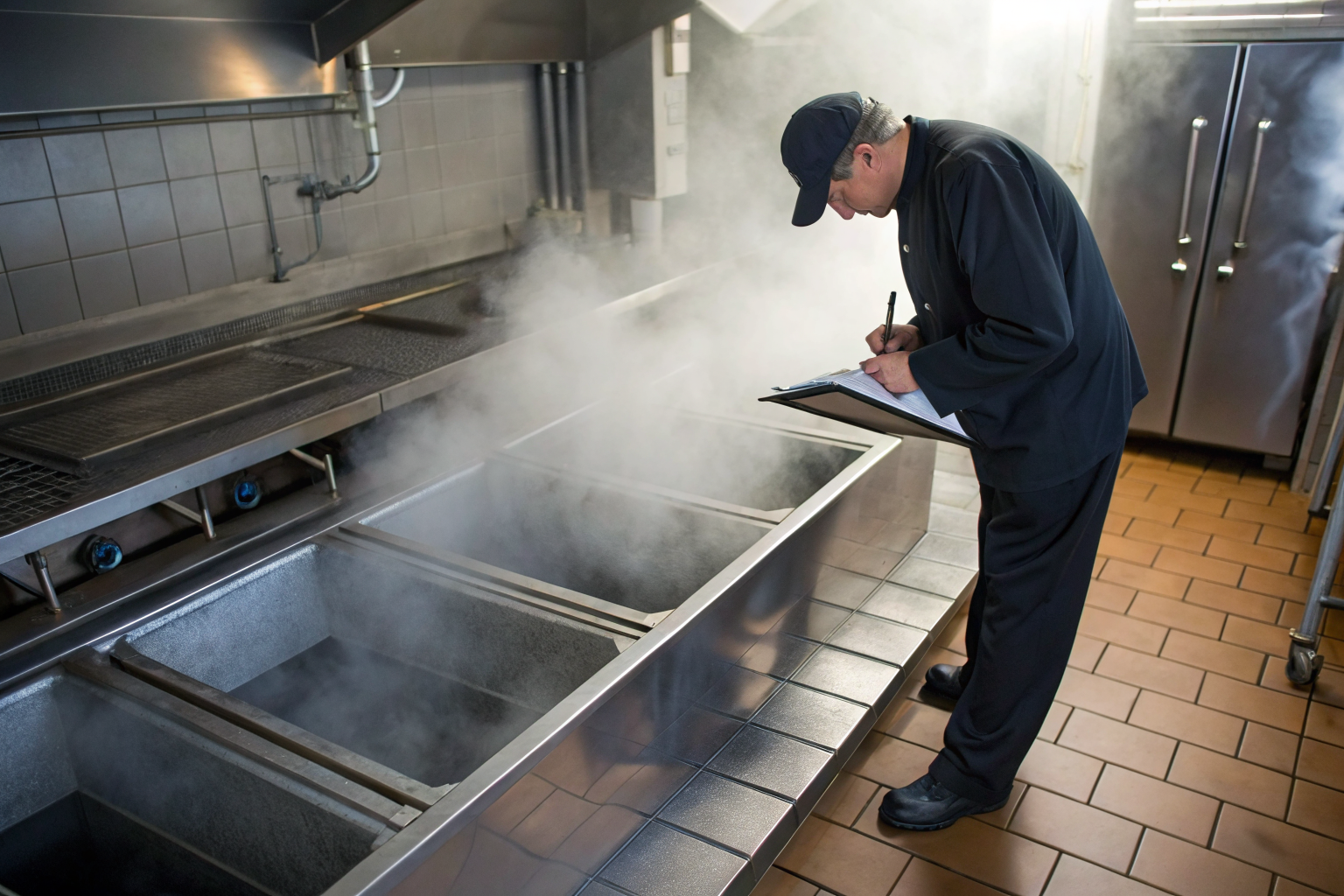
Inspection readiness preparation prevents FOG violation citation by ensuring all required evidence and access points are available when inspectors arrive. Restaurants with complete audit prep reduce violation citations by 73% compared to unprepared establishments.
• Organize all 14 document types in chronological order with quick-reference tabs. Inspectors expect immediate document access and time delays create negative audit impressions.
• Clear physical access paths to all trap components, sampling ports, and cleanout locations. Blocked access points result in automatic accessibility violations regardless of system condition.
• Prepare measurement tools including FOG thickness gauge, pH strips, and flow measurement equipment. Inspectors may request real-time measurements to verify recorded data accuracy.
• Schedule key personnel to be present during inspection including FOG program coordinator and maintenance staff. Missing personnel delays the audit and may require rescheduling with associated penalties.
• Conduct pre-audit system inspection to identify and correct any obvious violations before official review. Self-identified problems corrected before inspection show regulatory good faith.
Inspectors arrive unannounced for surprise audits at restaurants with previous violations or neighbor complaints. Standard audit preparation should be maintained continuously rather than scrambled together after receiving inspection notice. Documentation gaps discovered during preparation can be addressed through expedited record reconstruction if caught early enough.
Operational Compliance Monitoring Tasks

Operational compliance monitoring tracks fats oils and grease levels through weekly measurement protocols that identify problems before they trigger violations. FOG levels above 25% trigger automatic violations in most jurisdictions, making consistent monitoring essential for avoiding penalties.
Restaurants must document specific measurements at predetermined intervals and maintain logs that demonstrate pattern recognition and corrective actions. The monitoring schedule varies based on kitchen volume and previous compliance history.
| Monitoring Task | Frequency | Violation Threshold |
|---|---|---|
| FOG Layer Measurement | Weekly | >25% of total depth |
| Inlet Flow Testing | Monthly | >110% of design capacity |
| pH Level Documentation | Weekly | <6.0 or >9.0 |
| Temperature Recording | Daily | >140°F at discharge |
| Solids Accumulation Check | Bi-weekly | >30% of storage volume |
Weekly FOG measurements require standardized techniques using calibrated depth gauges and specific sampling locations. Measurement inconsistencies between staff members indicate training gaps that inspectors flag during audits.
Record-keeping formats must include measurement values, staff signatures, corrective actions taken, and follow-up verification dates. Incomplete logs receive the same violation severity as missing logs entirely. Digital monitoring systems that automatically timestamp and backup measurements show higher compliance rates but still require manual oversight and signature verification.
Ongoing Compliance Maintenance Schedule

Ongoing compliance maintenance follows quarterly verification protocol to prevent permit lapses and maintain continuous regulatory standing. Violation prevention protocols built into maintenance schedules catch problems during routine service rather than emergency responses.
Conduct monthly system performance reviews including flow rate verification and FOG accumulation trending. Performance degradation patterns predict violations before they occur.
Schedule quarterly professional inspections with certified technicians who provide compliance verification documentation. Third-party verification carries more weight during regulatory audits than self-reporting.
Perform annual permit renewal submissions with updated capacity calculations and operational data summaries. Late renewals trigger automatic non-compliance status regardless of system performance.
Execute semi-annual staff training refreshers covering measurement techniques, documentation requirements, and emergency response procedures. Staff turnover creates compliance gaps unless training schedules are maintained.
Complete yearly waste hauler contract reviews ensuring proper licensing, disposal site authorization, and manifest documentation procedures. Unlicensed haulers void waste disposal compliance even if all other requirements are met.
Quarterly compliance reviews prevent 89% of preventable violations by catching maintenance needs, documentation gaps, and operational changes before they become regulatory problems. The maintenance schedule must account for seasonal volume changes, staff scheduling, and equipment replacement cycles.
Restaurants that skip scheduled maintenance tasks face cascading compliance failures where one missed item triggers multiple violation categories. According to most regulatory guidelines, consistent maintenance documentation serves as evidence of good faith compliance efforts during violation hearings.
Frequently Asked Questions
What happens if I fail a grease trap compliance inspection?
Failed inspections typically result in a 30-day correction notice under EPA 40 CFR 403. If violations are not corrected, restaurants face fines ranging from $2,500-$25,000 plus potential permit suspension. Repeat violations can trigger daily penalty assessments until compliance is achieved.
How often do restaurants get compliance inspections?
Most jurisdictions conduct annual compliance inspections for restaurants with FOG control programs. High-volume establishments or those with previous violations may face quarterly inspections. Surprise inspections can occur if neighboring businesses report wastewater violations or if there are downstream system problems.
Can I handle grease trap compliance myself or do I need a professional?
While restaurants can handle basic documentation and monitoring tasks, installation verification and permit applications typically require certified professionals. Most jurisdictions require licensed plumbers for installation compliance and may require environmental consultants for complex FOG control program development. Consult a qualified environmental compliance professional for advice specific to your situation.