

Low profile grease trap installations solve the problem when your kitchen ceiling sits 7 feet high or your floor slab runs 18 inches thick. Standard grease trap types won’t fit these space constraints, but compact models maintain full GPM capacity while reducing height by half.
Key Takeaways:
- Low-profile grease traps reduce height by 40-60% compared to standard units while maintaining the same GPM capacity
- Most low-profile units handle 7-50 GPM flow rates with heights ranging from 12-18 inches versus 24-30 inches for standard models
- Uniform Plumbing Code accepts low-profile configurations provided they meet minimum retention time requirements of 30 seconds
When Do You Need a Low-Profile Grease Trap?

A low-profile grease trap is a gravity grease interceptor designed with reduced vertical dimensions for installations with height restrictions. This means you can install proper grease separation equipment where standard units won’t fit physically.
Ceiling height restrictions under 8 feet force low-profile selection in basement kitchens, converted spaces, and mobile food operations. Standard grease traps require 24-30 inches of vertical clearance while low-profile units need only 12-18 inches. Shallow floor trenches under 24 inches also mandate compact designs since excavation depth limits prevent standard installations.
Under-counter installations with limited vertical clearance represent the most common low-profile application. Food trucks, kiosks, and small restaurant spaces often lack the floor-to-ceiling clearance for standard commercial grease trap installations. The reduced height maintains separation efficiency while fitting restricted spaces.
Structural limitations matter too. Some buildings can’t support the excavation required for full-depth installations, making low-profile configurations the only viable option. Concrete slab thickness, existing utilities, and foundation constraints all drive low-profile selection in retrofit situations.
Low-Profile Grease Trap Options by GPM Rating
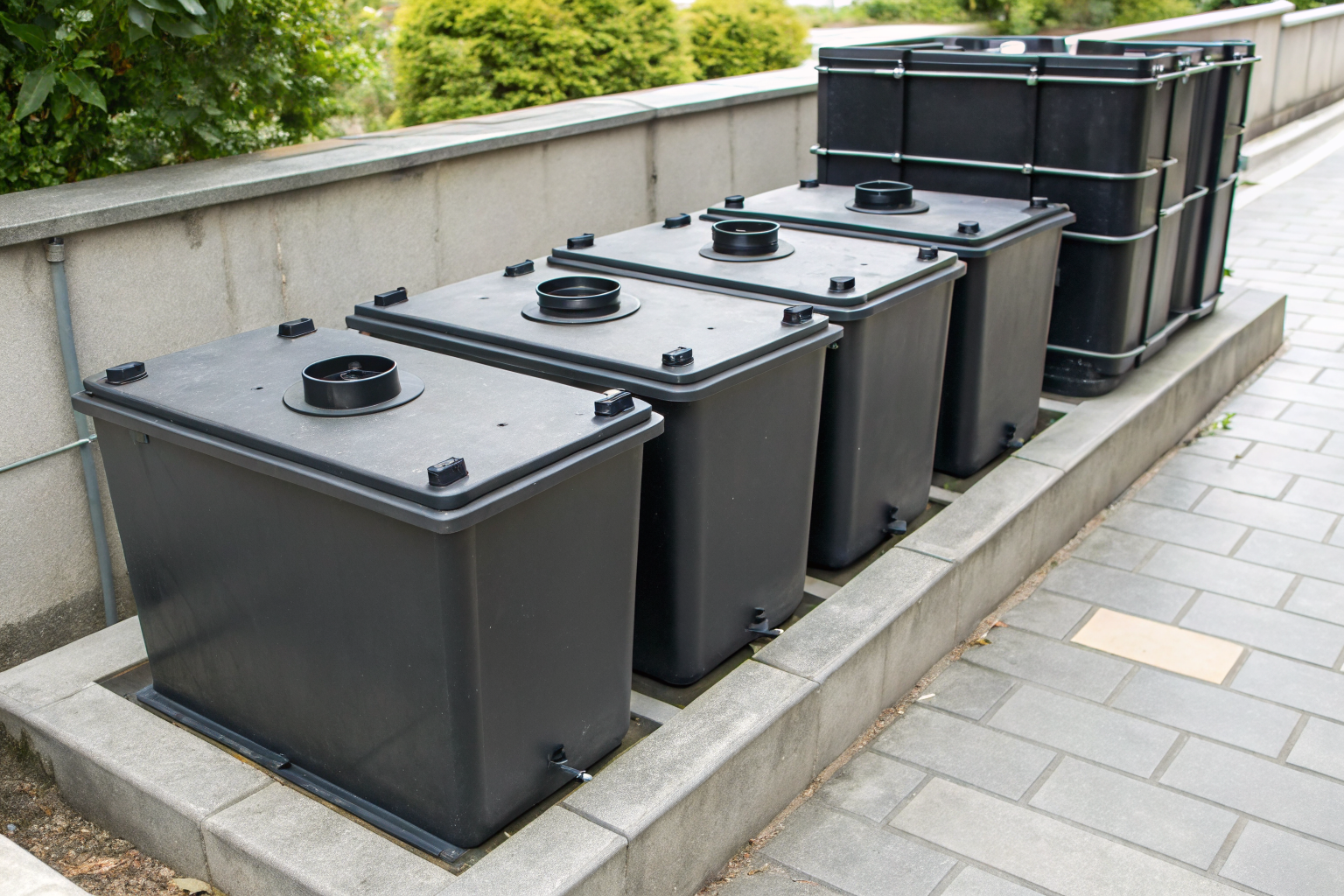
Low-profile grease traps offer multiple GPM capacities across different height specifications. Each capacity maintains proper retention time while reducing vertical dimensions significantly compared to standard hydromechanical grease trap designs.
| GPM Rating | Height (inches) | Length (inches) | Width (inches) | Price Range |
|---|---|---|---|---|
| 7 GPM | 12 | 36 | 18 | $800-1200 |
| 14 GPM | 14 | 42 | 21 | $1100-1600 |
| 20 GPM | 14 | 48 | 24 | $1400-2000 |
| 25 GPM | 16 | 54 | 24 | $1700-2400 |
| 35 GPM | 16 | 60 | 30 | $2200-2900 |
| 50 GPM | 18 | 72 | 30 | $2800-3200 |
Automatic grease removal device options add $1500-3000 to base pricing but eliminate manual cleaning requirements. These systems work within the same compact footprint while providing automated FOG removal through mechanical skimming or pumping systems.
Flow rate capacity doesn’t change with height reduction. A 20 GPM low-profile unit processes the same volume as a standard 20 GPM model. The engineering focuses on maintaining separation efficiency within the compressed vertical space through optimized baffle design and flow patterns.
Manufacturers achieve the height reduction by redesigning internal components rather than compromising capacity. Inlet and outlet positions adjust to work with the compressed dimensions while preserving the hydraulic retention time required for proper grease separation.
Height and Footprint Specifications for Compact Units

Low-profile dimensions differ significantly from standard trap measurements across all capacity ranges. The height reduction comes with specific footprint requirements that affect installation planning and space allocation.
| Specification | 14 GPM Low-Profile | 14 GPM Standard | 25 GPM Low-Profile | 25 GPM Standard |
|---|---|---|---|---|
| Height | 14 inches | 26 inches | 16 inches | 28 inches |
| Length | 42 inches | 42 inches | 54 inches | 54 inches |
| Width | 21 inches | 21 inches | 24 inches | 24 inches |
| Weight (empty) | 95 lbs | 110 lbs | 140 lbs | 165 lbs |
| Inlet Position | Side/Top | Top | Side/Top | Top |
| Outlet Position | Side | Bottom | Side | Bottom |
Weight specifications matter for structural calculations since low-profile units concentrate the same mass in a smaller vertical profile. The reduced height creates different load distribution patterns that affect floor support requirements and mounting considerations.
Footprint length and width requirements remain consistent with standard models of equivalent GPM rating. The space savings come entirely from height reduction, not horizontal compression. This maintains proper flow patterns and retention time within the compact vertical envelope.
Inlet and outlet positioning differs significantly in low-profile configurations. Side-mounted connections accommodate the reduced height while maintaining proper hydraulic flow patterns. Some models offer flexible connection options to work with existing plumbing configurations during retrofits.
A low-profile 20 GPM unit measures 48 inches long by 24 inches wide by 14 inches high versus 48x24x26 for standard models. This 12-inch height reduction opens installation possibilities in spaces where standard units won’t fit physically.
Do Low-Profile Grease Traps Meet Code Requirements?

Uniform Plumbing Code accepts low-profile grease trap installations provided they meet the same performance standards as standard height units. The code focuses on retention time and separation efficiency rather than specific dimensional requirements.
UPC Section 1003.3.4.3 requires minimum 30-second retention time regardless of trap height configuration. Low-profile designs achieve this through optimized internal flow patterns that maintain proper hydraulic residence time within the compressed vertical space. Manufacturers engineer baffle systems and flow channels to preserve separation efficiency.
Jurisdictional variations exist in low-profile approval processes. Some local authorities require additional documentation proving retention time compliance for compact designs. Submit manufacturer test data showing hydraulic performance when applying for permits on low-profile installations.
Inspection requirements specific to low-profile installations focus on proper flow patterns and grease layer formation. Inspectors verify that the reduced height doesn’t compromise separation performance or create flow shortcuts that bypass the grease retention zone.
Fats oils and grease (FOG) removal efficiency must match standard units of equivalent GPM rating. Testing protocols measure separation performance under identical flow conditions to verify that height reduction doesn’t affect grease capture rates. Most jurisdictions accept manufacturer certification data for code compliance verification.
Retrofit installations face additional scrutiny since existing plumbing may not provide optimal flow conditions for compact units. Verify pipe slopes and connection angles provide proper drainage with the reduced height profile before finalizing low-profile selection.
Best Low-Profile Grease Trap Manufacturers and Models

Leading manufacturers produce code-compliant low-profile grease traps across multiple GPM ranges with proven performance records in space-constrained installations.
Zurn GT2700 Series offers low-profile options from 7-50 GPM with heights starting at 12 inches. The stainless steel construction includes 5-year warranty coverage and NSF certification. Lead times run 4-6 weeks with pricing from $900-3100 depending on capacity.
Thermaco Big Dipper Series provides compact automatic grease removal device options with 18-inch maximum height. Models handle 6-75 GPM flows with integrated skimming systems that eliminate manual cleaning. Expect $3500-8000 pricing for automated low-profile units.
Canplas Endura Series manufactures polyethylene low-profile traps with 14-16 inch heights across 10-35 GPM capacities. The lightweight construction simplifies installation while maintaining structural integrity. Pricing ranges $700-2200 with 2-year warranty coverage.
Watts Grease Guardian Series offers hydromechanical grease trap designs optimized for tight spaces. Heights range 13-17 inches with flow capacities up to 50 GPM. Stainless steel models include 10-year warranty with pricing from $1200-2800.
Jay R. Smith 8000 Series provides low-profile gravity grease interceptor options with side-entry configurations for retrofit applications. Heights start at 15 inches with capacities from 15-40 GPM. Cast iron construction offers durability with $1000-2500 pricing.
Availability varies by region with some manufacturers requiring special orders for low-profile configurations. Contact local distributors to verify stock availability and current lead times before specifying specific models for project timelines.
Frequently Asked Questions
Can I retrofit a low-profile grease trap in an existing installation?
Most low-profile grease traps use standard pipe connections and can replace existing units. However, you’ll need to verify that your current plumbing configuration provides adequate slope for proper drainage with the reduced height.
Do low-profile grease traps require more frequent cleaning?
Low-profile grease traps maintain the same cleaning frequency as standard units of equivalent GPM rating. The reduced height doesn’t affect grease accumulation rates or separation efficiency when properly sized.
What’s the maximum GPM available in low-profile configurations?
Most manufacturers offer low-profile grease traps up to 50 GPM capacity. Above 50 GPM, the retention time requirements typically force larger dimensions that eliminate the low-profile advantage.